

Reclaiming the Nations
You are a Jew. A short while ago, a man named Jesus of Nazareth was crucified at the behest of the Sanhedrin, performed by Roman soldiers, and buried in a tomb. There are rumors about this man rising from death, at least according to his followers and around 500 other people who claim to be witnesses. It’s 50 days after celebrating the second day of Passover. The barley sheaf has been offered up to God by the priests, and it’s time to celebrate the feast of weeks, aka, the Feast of Pentecost. But this day of Pentecost was different.
Suddenly, these followers of Jesus have flames resting on them. You know these men are from Galilee, but they seem to be speaking in a language that everyone can understand. There are people from all over the near-eastern world - people from Mesopotamia, Cretans, Arabs, even visitors from Rome. Every person from every place could understand these simple men from Galilee. Suddenly, the entire crowd from the ends of the earth were gathered, focus taken off the Jewish celebration, and onto this phenomena that seemed to be divine in nature.
This is the scene we’re set up in Acts 2. Aside from the resurrection of Jesus Christ, this may perhaps be the most pivotal moment in history. You see, the day of Pentecost was a reversal of Babel. Recall how humanity started out in Genesis.
Genesis 11:1 (CSB) — 1 The whole earth had the same language and vocabulary.
There was no language barrier, the entire world, small as it may have been after the flood, was unified. But, humanity used this unity not to honor God, but chose to build a tower, known as a ziggurat (see illustration below). This ziggurat was traditionally used to connect the people with their god. As legend has it, their god(s) would come down to live on this tower. This was sacred space. Essentially, they were meant to connect heaven to earth, to allow their god a space to come down and bless their humans.
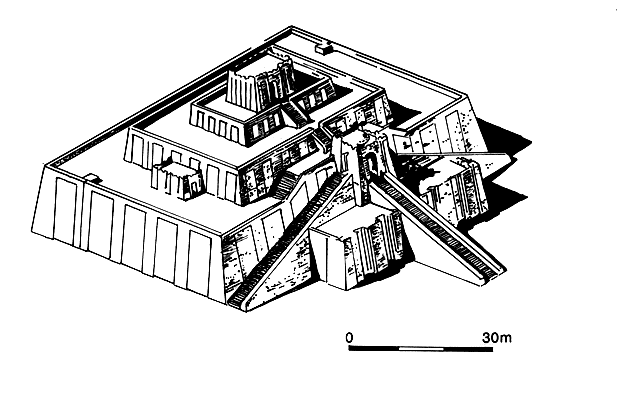
Reconstruction of Ur-Nammu’s ziggurat at Ur.
Paul Zimansky, “Art and Architecture: Ancient Near Eastern Architecture,” in The Anchor Yale Bible Dictionary, ed. David Noel Freedman (New York: Doubleday, 1992), 413.
While this could be defended as an act of humanity attempting to connect with God, He saw this the same way as Adam and Eve partaking of the fruit. Their heart behind building the tower was an offense to God.
Genesis 11:4 (CSB) — 4 And they said, “Come, let’s build ourselves a city and a tower with its top in the sky. Let’s make a name for ourselves; otherwise, we will be scattered throughout the earth.”
Come, let’s make a name for ourselves. At this, God’s heart broke. And He was forced, once again, to take action. Except this time, it was final.
Genesis 11:7–8 (CSB) — 7 Come, let’s go down there and confuse their language so that they will not understand one another’s speech.” 8 So from there the Lord scattered them throughout the earth, and they stopped building the city.
And interestingly, the author of Deuteronomy expands on this incident.
Deuteronomy 32:8 (CSB) — 8 When the Most High gave the nations their inheritance and divided the human race, he set the boundaries of the peoples according to the number of the people of Israel.
In a final act to save His people, God disinherited the nations. He confused their language. Once again, there was chaos, rivalry, worship to other gods, and the surface of the earth was once again a wasteland. But, fast forward to Pentecost. God has a plan.
Remember what happened on the day of Pentecost. Everyone could understand what the disciples were saying. Not in some universal language, but everyone was hearing this message in they own, native tongue. In an instant, Babel was reversed. They were no longer baffled that they couldn’t speak to one another, they were baffled that they could perfectly understand one another. And of course, what was the message? It was the good news, the gospel of Jesus Christ.
No longer was God reserved for the Hebrew nation, no, God was available to everyone. At Jesus’s death, the curtain separating the people from the inside of the temple was torn in two. No longer did God bind Himself to the temple, or to the borders of a land mass, or to genetics or religion. God Himself, in the Holy Spirit, was available for everyone. Jesus Christ, his gospel could be heard and understood by every language. God is, and always has been, for all the people. Now, He’s completley available to all who profess.
Here’s what believers today can take from this: we have the power in us, the Holy Spirit, to be ministers for the Kingdom of God. And our job is to take it all over the world, to all nations. Because we have been reinherited by God, we are now in His family, in His household. That means there is no superior people, language, culture, people, we are all brothers and sisters of God’s creation.
Galatians 3:28 (CSB) — 28 There is no Jew or Greek, slave or free, male and female; since you are all one in Christ Jesus.
That means, we must treat all of humanity as God’s image, the imago dei. It’s really easy to write off other people as inferior, especially if they have a different life than us. As Christians, we must be willing to be around those who live differently than us. After all, this is exactly what Jesus did. God paid the price by letting Jesus die on the cross for our unity, and when we reject people based on our differences, we make Jesus’s death meaningless.
Just take language for example. When we encounter another language, we get defensive, scared, and expect them to step up and learn our own language. Common language can bring a huge amount of unity, but is often a huge barrier in reaching other people. Rather than looking at language as an impassable barrier, we need to look at it as a sign that we are sinful people, and we have broken unity with our fellow humans. Our goal should be to reverse that, to do what God did, and unite all nations. We must stop living in a world of superiority by standing on our language, and stoop down to truly connect with those around us.
Matthew 28:19 (CSB) — 19 Go, therefore, and make disciples of all nations, baptizing them in the name of the Father and of the Son and of the Holy Spirit,
Here in the United States, we’re a melting pot of cultures and nations. This is just like first century Palestine. You don’t have to venture far to find a different culture and language. But instead of using this to our advantage, we barricade ourselves in our social and cultural circles, and hide. This is not what we’re called to, as Christians.
There is no superior people, nation, language, people group, or culture. Rather, God sent the Holy Spirit to unite us all, in Christ Jesus who resurrected from the dead. We need not squander that gift, but use it to reach ALL nations, for the love and mercy of Christ. So, if you’re reading this, go out and be uncomfortable. Be vulnerable. Learn a language to connect. Treat those around you as you want to be treated. Most importantly, love all people as a creation of God, and let the wonderful gift of the Holy Spirit permeate your soul and overflow into other people. Be the ambassador you’re called to be.
